
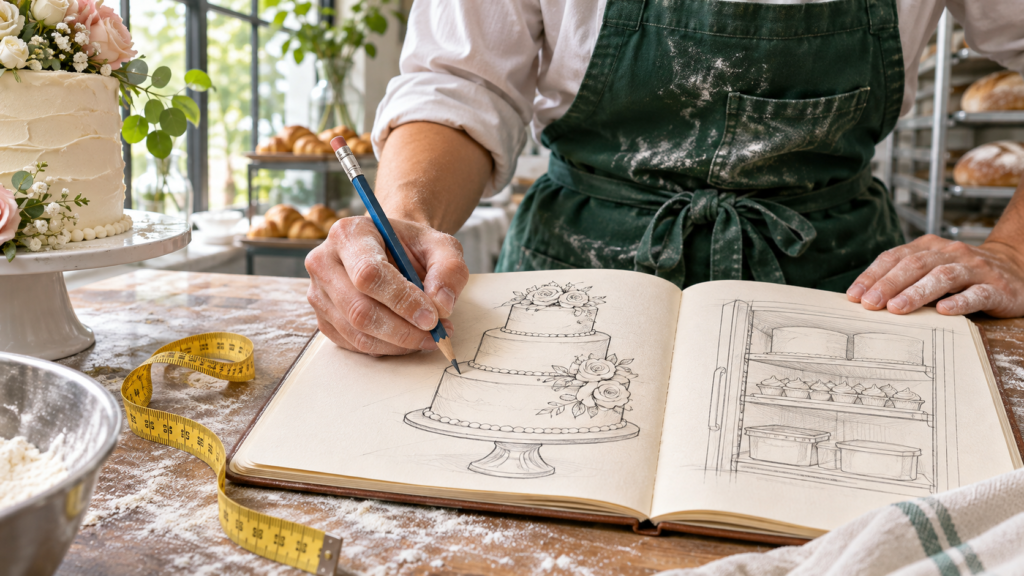
A bakery owner wants to explain why a wedding cake order starts with a sketch. Ask an AI tool for a warm introduction and it may praise the bakery’s passion. Ask the baker what changes during the sketch and you might hear, “That’s when people realise a tall cake won’t fit in their fridge.” Now there’s a reason to keep reading.
Ask for an interview before asking for prose
Choose one reader and one question they actually ask. Paste the prompt below, then answer aloud if typing makes you sound formal. Three specific answers are enough to begin.
Interview me about [topic] for [reader]. Ask one question at a time. First ask for a real moment when this mattered. Then ask what I noticed, what choice I made and what happened. Wait for each answer. Before drafting, show me the details you intend to use and flag anything you would have to guess.Turn an answer into an opening
Here is a fictional practice answer from the baker. “I keep a blue pencil beside the order book. We use it to draw the shelf above the cake. One couple swapped a tall topper for sugar flowers after we measured.”
The detail I would underline is the blue pencil. It gives the reader something to picture and leads naturally into a practical question. A possible opening is “Before we choose the flowers, I draw your fridge shelf in blue pencil. That little line tells us how high the cake can go.” The example works because the detail explains a decision. For your business, use an incident you can stand behind.
Give the draft a human edit
- Circle the sentence that sounds most like something you would say to a customer. Move it up if it introduces the issue clearly.
- Underline every specific detail. Check each one against the interview and remove invented dialogue or results.
- Read the last paragraph aloud. Give the reader one action they can take, such as measuring the shelf before their consultation.
Run the interview in three passes
Give each pass a different job. First, collect the story. Next, pick the detail that explains a decision. Finally, shape that detail into something your reader can use. Keeping those jobs separate makes it easier to spot when a draft slips away from what you actually said.
Prompt 1 · Find the missing detail
Here are my interview answers: [paste answers]. Identify one moment where I made a decision, changed my mind, or noticed something a customer might miss. Ask me two follow-up questions about that moment, one at a time. Ask for an object, action, or exact wording I remember. If I cannot recall it, move on. Do not supply the detail yourself.Prompt 2 · Draft from the evidence
Write a [150-word post / 400-word article opening] for [specific reader] who wants to know [their question]. Start with [verified detail] and explain the decision it illustrates. Use only the facts in my answers. Put [CHECK] after any claim I need to verify. End with one action the reader can take before [their next decision]. After the draft, show the source answer for each specific claim.Try the same exercise for a different business. A bike mechanic might say that they squeeze the rear brake while rolling the bike backwards before looking for a new pad. Ask what that test tells them. The answer can become an opening about when to book a service. A real explanation of that test is worth more than a paragraph about dedication to quality.
Keep a small voice sample
Save a short passage you wrote or said naturally, with any private details removed. Give it to the AI beside the next interview and ask it to describe the sentence length, point of view and level of formality. Review those observations before asking it to write. A good draft still sounds like something you would say when a customer asks the question in person.
Reuse the interview for your next post
Save the unused questions alongside the draft. A question about transporting the cake deserves its own post and example. When several interviews circle the same customer decision, use the personal brand content strategy guide to plan a series around it.
Frequently asked questions
What should I give AI before it interviews me?
Name the reader, the question the article should answer and one incident you can describe from memory. Ask for one question at a time so the follow-ups can use what you actually say.
How do I check whether an AI draft sounds like me?
Read the draft aloud and compare it with a short sample you wrote or said naturally. Keep the phrases you would use with a customer and check every specific claim against your notes.